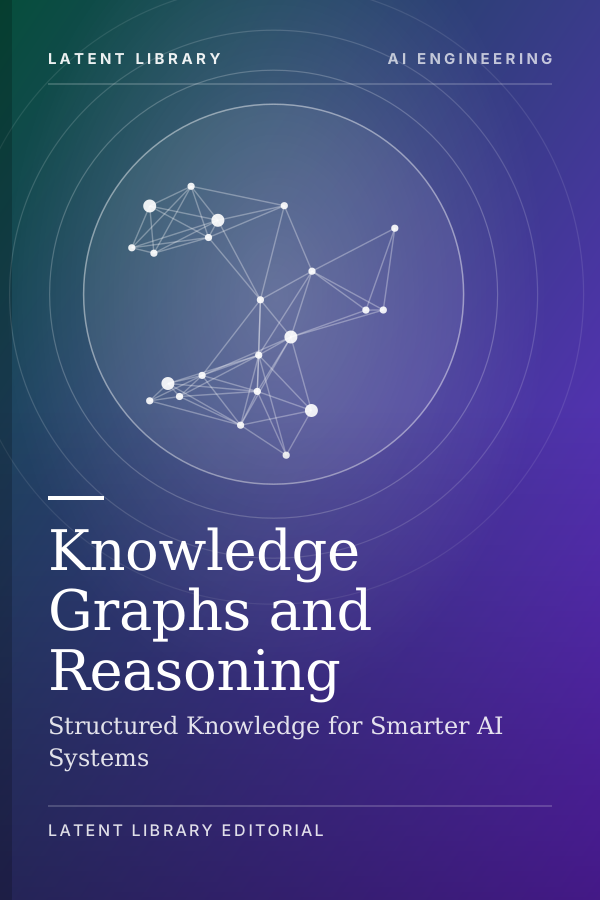
Knowledge Graphs and Reasoning
Structured Knowledge for Smarter AI Systems
- Pages
- 83
- Chapters
- 72
- Level
- Advanced
- Format
- E-book
About this book
Language models are fluent but forgetful about structure. Knowledge graphs store entities and their relationships explicitly, making some kinds of reasoning precise and checkable. Combined, they can do more than either alone.
This book covers modelling domains as graphs, ontologies and schemas, building graphs from structured data and text, entity resolution, querying with graph patterns, graph algorithms, graph embeddings, and combining graphs with language models for retrieval and question answering. Practical chapters address quality, maintenance and governance.
Examples use small graphs you can draw on paper.
What you will learn
- Modelling domains as entities and relationships
- Ontologies, schemas and identifiers
- Building graphs from data and text
- Entity resolution and quality
- Querying and graph algorithms
- Graph embeddings and combining graphs with language models
Table of contents
- IntroductionIntroduction
- Chapter 1Entities and Relationships
- Chapter 2Triples
- Chapter 3Why Graphs
- Chapter 4Graphs Versus Relational Databases
- Chapter 5Graphs Versus Vector Search
- Chapter 6Semantics
- Chapter 7Common Uses
- Chapter 8Public Knowledge Graphs
- Chapter 9Two Families: RDF and Property Graphs
- Chapter 10Starting Small
- Chapter 11What an Ontology Is
- Chapter 12Modelling From Questions
- Chapter 13Entity Types
- Chapter 14Relationship Types
- Chapter 15Properties or Nodes?
- Chapter 16Reusing Existing Vocabularies
- Chapter 17Identifiers
- Chapter 18Provenance
- Chapter 19Time
- Chapter 20Hierarchies and Taxonomies
- Chapter 21Constraints and Validation
- Chapter 22Evolving the Model
- Chapter 23Data Sources
- Chapter 24Mapping Structured Data
- Chapter 25Extracting From Text
- Chapter 26Extraction With Language Models
- Chapter 27Extraction Quality
- Chapter 28Entity Resolution
- Chapter 29Resolution Pitfalls
- Chapter 30Data Quality
- Chapter 31Storage Options
- Chapter 32Loading Pipelines
- Chapter 33Querying Property Graphs
- Chapter 34Querying RDF Graphs
- Chapter 35Query Performance
- Chapter 36Reasoning and Inference
- Chapter 37Graph Algorithms
- Chapter 38Graph Embeddings
- Chapter 39Link Prediction
- Chapter 40Semantic Search
- Chapter 41Recommendations
- Chapter 42Fraud Detection
- Chapter 43Impact Analysis
- Chapter 44Customer and Master Data Views
- Chapter 45Visualisation
- Chapter 46Analytics and Reporting
- Chapter 47Graphs and Language Models
- Chapter 48Natural Language to Graph Queries
- Chapter 49Graph-Enhanced Retrieval
- Chapter 50Building Graphs From Documents With Models
- Chapter 51Grounding and Citations
- Chapter 52Agents Using Graphs
- Chapter 53Governance
- Chapter 54Access Control
- Chapter 55Privacy
- Chapter 56Corrections and Feedback
- Chapter 57Monitoring
- Chapter 58Measuring Value
- Chapter 59Worked Example: Supplier Risk Graph
- Chapter 60Worked Example: Policy Question Answering
- Chapter 61Case Study: Retail Product Graph
- Chapter 62Case Study: Bank Fraud Graph
- Chapter 63Case Study: Research Knowledge Graph
- Chapter 64Case Study: IT Dependency Graph
- Chapter 65Common Pitfalls
- Chapter 66Team and Skills
- Chapter 67Modelling Checklist
- Chapter 68Build Checklist
- Chapter 69Template: Entity Type Definition
- Chapter 70Template: Relationship Definition
- Chapter 71A First-Project Plan
- Chapter 72Looking Ahead
- GlossaryGlossary
Who this book is for
Data engineers, architects and AI engineers working with complex, connected information.
Details
| Format | PDF + web edition |
|---|---|
| Length | 83 pages (approx.) |
| Chapters | 72 |
| Level | Advanced |
| Language | English |
| Topic | AI Engineering |
| Author | Latent Library Editorial |
Keep reading
You may also like
Building With Retrieval
Design, build and evaluate assistants that answer from your own documents accurately and with sources.
AI Agents in Practice
How to build AI agents that take real actions reliably: tools, loops, planning, memory, guardrails and testing.
Evaluating AI Systems
How to know whether an AI system really works: metrics, test sets, LLM judges, A/B tests and red teaming.
Recommender Systems in Practice
How to design, build and evaluate recommendation systems: collaborative filtering, content-based methods, embeddings, ranking and responsible design.